
AUTHORIZATION
Blog
IT support services for businesses
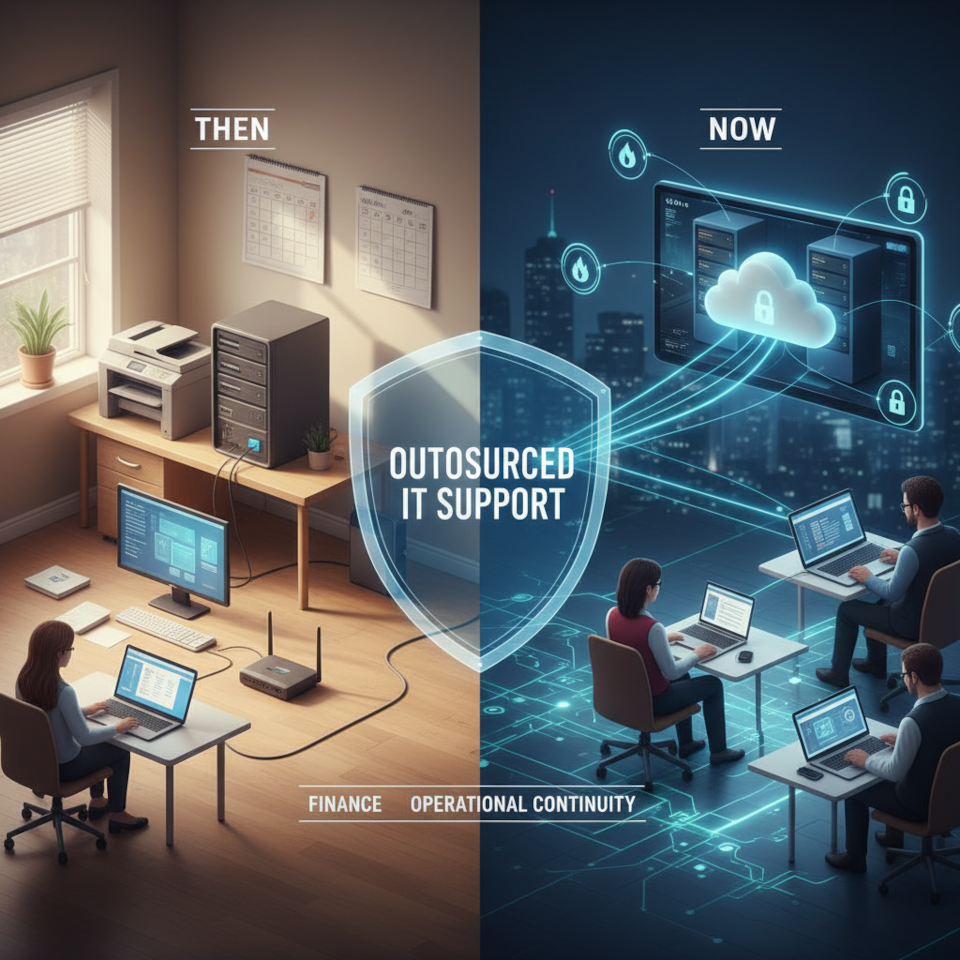
When an organization loses access to files, the email stops working, or a critical system is delayed, the problem is not just technical. It immediately becomes a question of finance, reputation, and operational continuity. Therefore, outsourced IT support for businesses is no longer a solution just for those without an in-house IT specialist. For many, it is a calculated management decision - to ensure stable daily maintenance, security, and clear technology oversight without the full costs of an internal IT department.
For small and medium-sized enterprises, the IT environment usually develops gradually. At first, a few computers, one server or cloud services, an internet connection, and a printer are sufficient. However, as the business grows, so does the risk. Remote work emerges, more users appear, access rights issues arise, the need for backups, cybersecurity requirements, and the necessity to make infrastructure decisions that affect the business for several years ahead.
It is precisely at this moment that outsourcing becomes valuable not just as a simple help desk but as a managed service with clear responsibilities. What is typically most important to management is not how quickly a broken computer is replaced. It is more important to know that the IT environment is monitored, incidents are addressed in priority order, and technology decisions do not leave the company vulnerable.
What outsourced IT support means for businesses in practice
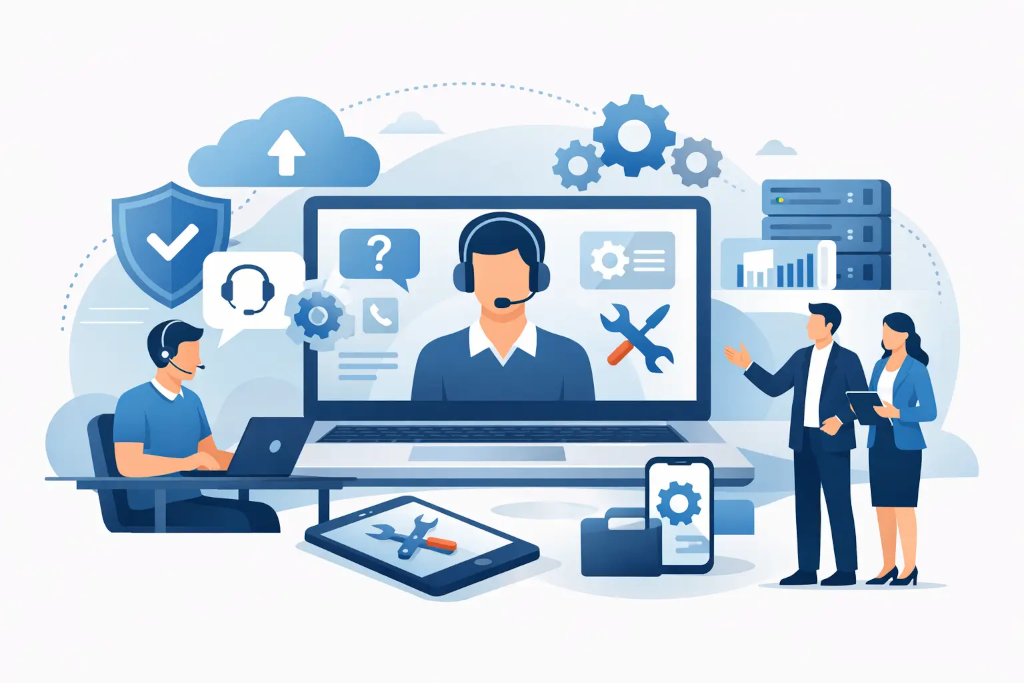
A good outsourcing model does not limit itself to on-demand calls. It includes daily user support, workplace management, server and network monitoring, access control, backups, security settings, and periodic environmental assessments. If the service is mature, planning is added - what needs to be updated, where the weak points are, what risks are not adequately managed.
This means one point of responsibility for the company. Not several suppliers who look for the culprit in case of issues, but a partner who sees the bigger picture and coordinates both daily maintenance and changes in infrastructure. This is particularly important in an environment where various manufacturers, cloud services, and business systems are used.
Predictability is also important. If IT is managed only reactively, costs usually arise at the most inconvenient time - after an incident, data loss, or prolonged downtime. Conversely, managed outsourcing transforms IT from an unpredictable expense item into a controllable operational function.
When an internal resource is no longer sufficient
In many companies, there is one IT specialist or employee who handles technical issues alongside their core duties. Initially, this may work. However, the limit is reached quickly - especially when continuous support is required, security requirements need to be implemented, and the infrastructure has become more complex.
The problem is not just capacity. Rarely does one person have in-depth knowledge of all areas at once - user support, networks, servers, cloud solutions, backups, security, and strategic planning. As a result, solutions arise that work in the short term but in the long term increase dependency on a specific person and reduce transparency.
The outsourcing approach here provides access to a team rather than just one specialist. This does not mean that the internal IT resource becomes superfluous. In some companies, a hybrid model works best, where an internal employee coordinates business needs while an external partner provides specialized expertise, monitoring, and continuity.
The cost question is not just about salary comparisons
Managers often start with a simple calculation - whether outsourcing costs less than hiring an IT employee. Such a comparison is understandable but incomplete. The real question is what kind of results the company gets for a particular budget.
The salary of a full-time employee is just part of the total costs. Vacation time, replacement, training, risks of specialized knowledge gaps, and the time management spends on coordination must be added. On the other hand, outsourcing contracts often include access to several specialists, documented processes, monitoring tools, and a clear division of responsibilities.
Of course, not all companies need the full extent of managed IT support. If the organization has a very simple environment, outsourcing may be just episodic assistance or the implementation of specific projects. However, in companies where IT directly affects sales, customer service, financial circulation, or production processes, the cheapest option often becomes the most expensive after the first serious disruption.
Security, backups, and incident recovery
One of the most common mistakes is thinking that IT support begins and ends with user assistance. In reality, the greatest value often lies in what the user does not see on a daily basis - access management, log monitoring, backup checks, updates, device policies, and readiness for disaster recovery.
If a company cannot quickly restore critical systems after an incident, technically it may be just a few hours of disruption, but in business terms - a serious loss. Therefore, the outsourcing partner must not only maintain the environment but also clearly define what happens if the worst-case scenario occurs. Where backups are stored, how quickly they can be restored, which systems are priorities, and which dependencies have not been sufficiently documented thus far.
Discipline is essential here, not promises. A backup that has not been tested is not a full-fledged protection. A security policy that no one follows is not security. That is why more and more companies choose partners who work with an auditable approach and regular controls, rather than just reacting to problems.
The strategic layer that is often undervalued
Many companies start looking for an external IT partner because something is not working. However, long-term value emerges when support evolves into strategic oversight. This means that the technology environment is not just maintained in its current state but is planned according to business goals.
For example, a company opens a new office, integrates an acquired business, migrates systems to the cloud, or implements a hybrid infrastructure. In such phases, it is not enough to have a technician who resolves a specific incident. A partner is needed who understands the impact on security, availability, cost structure, and manageability.
That is why some companies need not only support but also an external IT manager or CIO-level perspective. This helps management make decisions with clearer criteria - what to standardize, what to automate, what to move to the cloud, and where to maintain local control. Such a model is chosen in practice by companies for whom a full-time IT manager would be premature or economically unjustifiable.
How to evaluate a service provider
If a company seeks outsourced IT support, the first criterion is not the lowest price. More important is whether the provider is capable of taking responsibility for the environment that is critical to business operations. This means the ability to work with processes, documentation, priorities, and communication at the management level.
It is worth noting whether the service provider speaks only about individual technical tasks or also about operational continuity, risk mitigation, and management. This usually indicates the maturity level well. If the conversation is limited to how quickly a computer can be repaired, the company is likely to receive only fragmented assistance.
The implementation phase is also important. A quality partner assesses the existing environment before assuming full responsibility, identifies deficiencies, and sets priorities. Sometimes this reveals uncomfortable truths - incomplete backups, outdated servers, uncontrolled access, or insufficient documentation. However, this clarity is precisely what helps later to avoid unplanned disruptions.
Companies like KSK IT are in demand in this market not because they promise abstract technical assistance but because they connect daily support with infrastructure management, audits, disaster recovery readiness, and management-level technology oversight.
Outsourced IT support for businesses is not one-size-fits-all
It would be a mistake to assume that one model fits all businesses. A manufacturing company, where system availability on-site is crucial, will have different needs than a professional services firm that works almost entirely in the cloud. Regulatory requirements, the level of internal competency, and growth plans also significantly influence the content of the service.
Therefore, the right question is not whether outsourcing is better than internal IT. The right question is - what model of support and oversight allows the company to operate safely, continuously, and with controllable costs. Sometimes it will be full management; other times it will be hybrid cooperation, but in some cases, targeted audits and infrastructure organization will be necessary before the next phase of development.
If IT is a critical function in a company, it should not rely on improvisation. A stable outsourcing partner not only provides technical assistance but also gives management the confidence that the systems support the business rather than impede it. And this confidence becomes especially valuable at times when the company is growing, changing, or facing unforeseen risks.
