
AUTHORIZATION
Blog

What is infrastructure monitoring in a company?
Employees cannot access files, email is delayed, and the customer system becomes slow. In moments like these, the question is not only what has broken, but also how long the company has already been losing work time, revenue, and customer trust. What is infrastructure monitoring? It is the continuous monitoring of the IT environment that helps detect technical deviations before they turn into a business-disrupting incident.
In a small or medium-sized business, an IT problem rarely remains only an IT problem. If the warehouse system does not work, deliveries are delayed. If the accounting solution is unavailable, invoices are held up. If remote access is interrupted, the team cannot continue working. That is why monitoring is not just a tool for administrators - it is an element of business continuity management.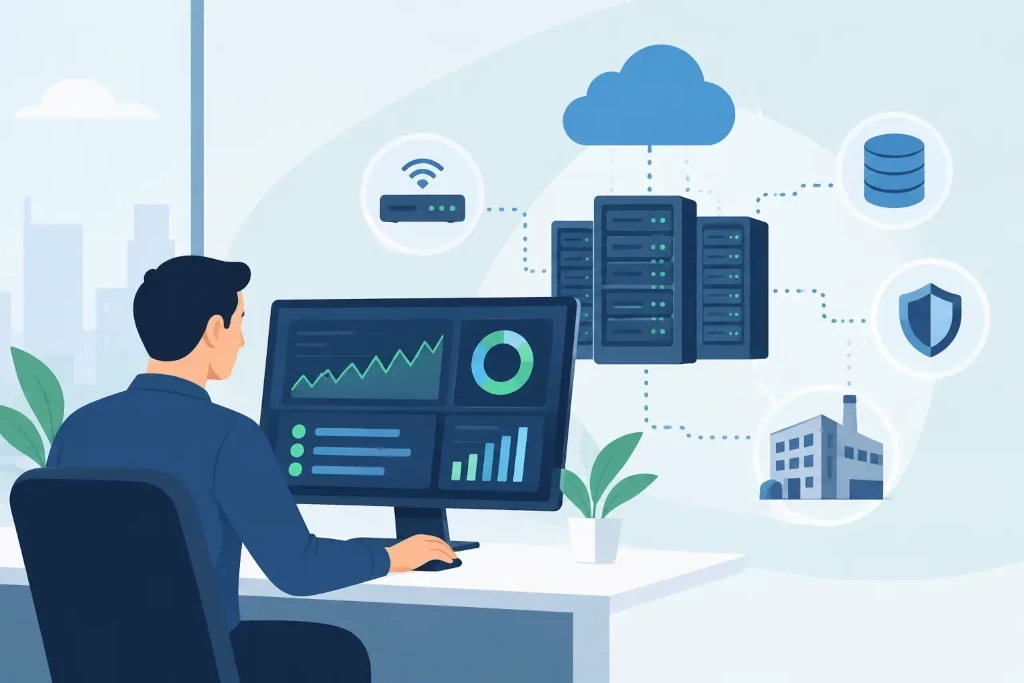
What infrastructure monitoring is and what it covers
Infrastructure monitoring is the measurement and analysis of the state of servers, networks, workstations, cloud services, data storage, and critical business applications. The monitoring system regularly checks specific parameters, compares them against acceptable thresholds, and sends an alert to the responsible team if a risk or failure appears.
In practice, this may mean that an IT specialist receives a notification about disk space running out before the server stops accepting new data. It may also detect unusually high processor load, an unstable internet connection, unavailable VPN access, or failed backup jobs. The goal is not simply to collect a lot of technical data. The goal is to take informed action in time.
Effective monitoring covers both local infrastructure in offices and data centers, as well as public cloud resources such as virtual servers and identity services. In a hybrid environment, this is especially important because the cause of a disruption may be anywhere in the chain: on the user's device, in the network, in a provider's service, or in the integration between systems.
Why reacting after user complaints is not enough
In companies without organized monitoring, IT problems are often noticed only when someone cannot do their work. This approach is reactive. It forces the team to look for the cause at a time when pressure is already high and the business process has stopped.
Proactive monitoring changes this sequence. Instead of waiting for the server to stop completely, the IT team sees the trend: memory usage is increasing, disk space is shrinking, or the number of network errors exceeds the norm. This gives time to make a planned fix, increase resources, replace a component, or adjust the configuration outside critical working hours.
However, monitoring does not guarantee that there will never be incidents. Hardware may fail unexpectedly, an external service may become unavailable, or a cyberattack may create a situation that requires a broader response. The value of monitoring is in the ability to detect a problem faster, assess its impact more precisely, and reduce downtime.
Which indicators are important for business operations
Not every technical measurement is equally important. Too many alerts create so-called alert fatigue - critical notifications get lost among minor signals. Therefore, the monitoring model must be based on service priorities and business risks.
Typically, server availability, processor and RAM load, disk space, storage performance, network connection quality, and firewall status are monitored. It is equally important to check whether backups are being created, whether they are successful, and whether data can be restored if needed. A backup that exists only in a report but cannot be restored does not provide real protection.
For business-critical systems, it is necessary to monitor not only the server on which they run, but also the service itself. For example, it is not enough to know that the virtual machine is powered on. You must check whether the application accepts requests, the database responds, and the main transaction process is truly available to users.
Monitoring, security, and backups
Infrastructure monitoring is not a complete substitute for cybersecurity. By itself, it does not stop phishing, does not implement access controls, and does not replace vulnerability management. However, it is an essential security layer because it helps detect suspicious changes and non-standard system behavior.
For example, an unusually rapid volume of file changes, unexpected server resource load, or a critical service restart may indicate malware, a faulty update, or unauthorized activity. For such a signal to be valuable, it must reach a person or team that can assess the situation and act according to a clear incident process.
The connection with the disaster recovery plan is direct. Monitoring shows that a disruption has occurred; backups and recovery procedures make it possible to restore work; while regular tests prove whether the plan also works under real pressure. A company needs all three parts, not just one of them.
How to implement monitoring without excessive complexity
The starting point is mapping critical services. Management and IT responsible staff must agree on which systems the company cannot lose even for a few hours, which can be unavailable for longer, and what impact arises in each scenario. This assessment determines what to monitor first and how quickly to respond.
Next, measurements, alert thresholds, and responsibilities must be defined. An alert about server unavailability at night is useless if it is not clear who receives it, how quickly they must respond, and in what order vendors or company management should be involved. The division of responsibility is just as important as the chosen technology.
It is advisable to start with the most important items rather than monitoring every possible parameter right away. Usually, the first stage includes the internet connection, firewall, servers, backups, email, file access, and central business systems. Once the first data is obtained, the monitoring configuration can be improved by removing unnecessary notifications and adding more detailed analysis.
Regular review of reports is also important. A monthly report may reveal recurring connection issues, insufficient resource capacity, or systems that often approach critical thresholds. These observations make it possible to plan budgets and infrastructure improvements rather than purchasing solutions in an urgent emergency mode.
When managed monitoring is needed
An internal IT team can manage monitoring if it has sufficient capacity, the necessary skills, and a clear on-call model. However, in smaller organizations, one IT specialist often simultaneously supports users, maintains systems, implements projects, and coordinates vendors. Continuous monitoring in such a situation may remain in the background.
Managed monitoring is suitable if the company needs regular supervision and escalation, but it is not practical to build a full-time team for this task. An external IT partner can combine technical monitoring with incident prevention, capacity planning, backup control, and management-friendly visibility. KSK IT links this approach with broader infrastructure management and business continuity requirements.
When evaluating a service, ask not only about the number of devices monitored. Find out who analyzes the alerts, what the response time is, how backups are checked, how escalation works, and what information management will receive regularly. A cheap solution that only sends automated emails does not always reduce business risk.
Monitoring becomes valuable when it turns technical signals into practical decisions: what should be fixed now, what should be planned for the next quarter, and where the company's operations are most exposed to risk. Start with a clear list of the most critical services and check whether someone would know about each of them before a customer or employee notices it.
